



INSIDE THE ASSESSMENT

What is Technology
Due Diligence?

One technology.
Two perspectives.
Better decisions.

Technology Due Diligence (Tech DD) is an independent examination of the product, engineering organization and processes behind a software business. It turns technical evidence into decisions about risk, growth and what to improve next.

A guided introduction to how senior technology advisors think.

THE STORY BEHIND THE SOFTWARE

The product is what you see.
The system behind it is what you invest in.

Great demos tell you what a product does. They rarely show how resilient the architecture is, how fast the team can deliver or how much effort the next stage of growth will require.

TechCheck looks beneath the interface. Not to collect technical facts for their own sake, but to understand what those facts mean for the business.

THE TECHCHECK X-RAY / INTERACTIVE

See the product.
Then see what's behind it.

Beautiful interfaces tell only one story. Move the scanner across a fictional software product to reveal TechCheck's three assessment dimensions: Product, Process and Organization.

TECHCHECK / SYSTEM INSPECTIONILLUSTRATIVE DEMONSTRATION
SURFACE / WHAT CUSTOMERS SEEPRODUCT · PROCESS · ORGANIZATION
DRAG OR USE THE ARROW KEYS54% REVEALED
01 / THE SURFACE

What does the product do?

Customers experience the features, interface and business outcomes.

02 / THE SYSTEM

Can the company keep delivering?

TechCheck assesses Product (application, data and cloud infrastructure), Process (development, testing and delivery), and Organization (people and capabilities).

Conceptual visualization only. Not a real software product, client assessment or quantified finding.

01 / OUR METHODOLOGY

Three dimensions.
One complete picture.

Every technology company is built on three interdependent foundations. Explore each to see the questions and evidence behind an assessment.

01 / THE TECHNOLOGY

Product

Can the technology support tomorrow's ambitions?

Architecture, technical debt, scalability, cloud, security, roadmap, data and AI.

Explore the evidence

Architecture and integration diagrams, technology versions, customer-impacting incidents, availability records, product releases, security controls and targeted code reviews.


02 / THE ENGINE

Process

How effectively does the organization turn ideas into software?

Development workflows, AI coding, testing, CI/CD, product management and operations.

Explore the evidence

Release practices, test automation, quality gates, use of AI development tools, incident processes, product prioritization, onboarding and customer support.

03 / THE PEOPLE

Organization

Can the team sustain and accelerate delivery?

Competencies, capacity, ownership, key-person dependencies, hiring and technology partners.

Explore the evidence

Team and competence maps, product ownership, development resource history, critical-role dependencies, sourcing arrangements and engineering leadership interviews.

THE EVIDENCE TRAIL / AN INTERACTIVE DEEP DIVE

From information to insight.

Select a dimension above or open a walkthrough below. Each shows what we examine, how an experienced CTO challenges it, and why the conclusions matter.

01Product
01 / THE TECHNOLOGY

Will the platform grow without multiplying complexity?

Follow how technical architecture and deployment evidence becomes a business decision.

01 / REQUEST
Architecture and integration maps

Application layers, APIs, data flows, deployment models and supported versions.

02 / VALIDATE
Walk through a real customer release

Challenge upgrade paths, environment variations, incident history and disaster recovery evidence.

03 / INTERPRET
Separate deliberate choices from friction

A dedicated deployment is not automatically a risk. Manual effort and unmanageable version drift may be.

EXAMPLE INPUTS

Possible evidence: architecture diagrams · installed versions · cloud environment and SLA history · recovery tests

Engagement scope determines which materials are needed. This is not a fixed checklist.
INVESTOR INTERPRETATION
Understand the cost and feasibility of scale.

Can onboarding, upgrades and support grow economically with the customer base? Identify what evidence supports growth assumptions, and where investment might be required.

TECH MANAGEMENT INTERPRETATION
Turn complexity into a manageable roadmap.

Identify which deployment differences serve customers and which should be standardized. Prioritize repeatable releases, automation and resilient operations.

See what TechCheck delivers
02Process
02 / THE ENGINE

How reliably does the organization turn change into value?

Go beyond agile labels and dashboard metrics to examine real development and operational workflows.

01 / REQUEST
Delivery and quality evidence

CI/CD, test coverage and mix, recent releases, customer-impacting defects and AI coding tool usage.

02 / VALIDATE
Trace a change through production

Inspect review and testing controls, release decisions, rollback paths and how AI-generated code is validated.

03 / INTERPRET
Measure outcomes, not activity

Fast commits, green builds or AI adoption alone do not prove engineering quality or customer value.

EXAMPLE INPUTS

Possible evidence: SDLC and test documentation · incident logs · commit analytics · AI development workflow

Engagement scope determines which materials are needed. This is not a fixed checklist.
INVESTOR INTERPRETATION
Assess execution predictability and operational exposure.

Establish whether the team can deliver the roadmap while keeping reliability, maintenance and security risks under control.

TECH MANAGEMENT INTERPRETATION
Make engineering faster and safer.

Find bottlenecks in planning, code review, testing and deployment; prioritize controls that improve quality without adding unnecessary process.

See what TechCheck delivers
03Organization
03 / THE PEOPLE

Could the platform be operated and evolved without a single expert?

See how a team and competence assessment reveals structural strengths as well as dependencies.

01 / REQUEST
Team, role and contribution evidence

Development roster, internal/external roles, start dates, key-system ownership and contribution history.

02 / VALIDATE
Test continuity, not just activity

Interview engineers, review onboarding documentation and follow how changes and incidents are handled.

03 / INTERPRET
Distinguish leadership from dependency

A prolific developer is not inherently a bottleneck. Ownership, access and resilience must be assessed together.

EXAMPLE INPUTS

Possible evidence: developer resource matrix · component ownership · commit history · onboarding and hiring plans

Engagement scope determines which materials are needed. This is not a fixed checklist.
INVESTOR INTERPRETATION
Test whether the investment thesis depends on a few people.

Understand continuity, succession and capacity. Evaluate whether critical skills can support growth and whether a mitigation plan is realistic.

TECH MANAGEMENT INTERPRETATION
Strengthen the team without losing momentum.

Make knowledge transferable, clarify ownership, build secondary expertise and focus hiring or sourcing where it changes delivery capability.

See what TechCheck delivers

Same evidence base. Different questions depending on who needs to act on the findings.

CHANGE YOUR LENS
Same assessment. Different value.

02 / THE DECISION

INVESTOR PERSPECTIVE

Know what you're buying.

Can this business deliver the investment thesis? TechCheck connects technical reality with risks, required investment and opportunities to create value.

01 / SCALE

Can the platform support the growth plan?

Assess architectural constraints, scalability and investment needed to serve more users, products or markets.

02 / RISK

What could threaten enterprise value?

Identify technical debt, security exposure, operational fragility and key-person dependencies.

03 / COMPETE

Can the product stay relevant?

Review technical differentiation, roadmap feasibility and exposure to AI-driven market shifts.

04 / EXECUTE

Can the organization deliver?

Understand engineering capacity, delivery efficiency and the implications for the investment case.

TECH MANAGEMENT PERSPECTIVE

Know what you've built.

Where is your technology strongest, and what will unlock the next stage of growth? Get an outside perspective that challenges assumptions and helps you prioritize.

01 / ARCHITECTURE

Are we making the right technical decisions?

Validate what works, what should evolve and where modernization would create the most value.

02 / ENGINEERING

Where are we losing speed or quality?

Uncover bottlenecks across development, testing, release practices and AI-assisted coding.

03 / PEOPLE

How resilient is our team?

Identify concentrated knowledge, competency gaps and opportunities to strengthen technical ownership.

04 / NEXT STEPS

What should we improve first?

Connect the roadmap, technical debt and engineering capabilities to practical priorities.

03 / THE DISCOVERY LAB

Don't just read the findings.
Make the call.

Three signals from the world of software. Explore the evidence, make your initial judgement and see how an experienced CTO builds a defensible conclusion.

TECHCHECK / EVIDENCE LAB
01 / 03
01 / 03   PRODUCT / ARCHITECTURE & CLOUD INFRASTRUCTUREILLUSTRATIVE CASE STUDY

A product that works. But can it scale?

New enterprise customers get a dedicated cloud deployment, with environment-specific scripts and separate component versions. The demos are excellent. The operating model is less clear.

SCALING SIGNAL / INPUTOBSERVATION

WHAT THE EVIDENCE SUGGESTS

Customer onboarding appears to depend on manual deployment and customer-specific changes.

Release modelCustomer-specific scripts
VersionsDifferent versions in use
OperationsManual configuration steps

Fictional illustrative scenario. No client data or measured performance indicators.

YOUR TURN / MAKE THE CALL

Is this a serious obstacle to growth?

Choose the interpretation you would start with. Then unlock how TechX would investigate it.

Is this a serious obstacle to growth?
TECHX / THE EXPERT VIEWLOOK DEEPER

The deployment model is not the verdict.

A separate customer environment is not automatically technical debt. The real test is whether the platform can be deployed, upgraded, secured and supported predictably at the scale the business plan requires.

The evidence we would validate
  • Compare version and customer deployment inventories.
  • Inspect deployment automation, infrastructure-as-code and upgrade steps.
  • Review onboarding effort, availability incidents and the incremental cost of each environment.

INVESTOR PERSPECTIVE

Can growth translate into attractive economics?

Assess whether new customer onboarding and support scale with revenue or require disproportionate engineering effort. Estimate the modernization effort only after reviewing the deployment evidence.

Decision input: cost-to-scale, delivery capacity and roadmap investment.

TECH MANAGEMENT PERSPECTIVE

Where can we make delivery repeatable?

Identify which customer variations are intentional and which are avoidable. Prioritize consistent release management, environment provisioning, shared components and measured onboarding effort.

Improvement path: standardization, automation and clear version support.
02 / 03   PROCESS / ENGINEERINGILLUSTRATIVE CASE STUDY

The pipeline is green. Production isn't.

Builds pass automated checks and releases are frequent. Yet serious customer-facing defects still appear after deployment, with recurring manual recovery work.

QUALITY SIGNAL / INPUTOBSERVATION

WHAT THE EVIDENCE SUGGESTS

Passing pipeline checks do not appear to predict production reliability.

Continuous integrationBuilds passing
ProductionRecurring incidents
RecoveryManual interventions

Fictional illustrative scenario. No client data or measured performance indicators.

YOUR TURN / MAKE THE CALL

What does a green pipeline actually prove?

Choose the interpretation you would start with. Then unlock how TechX would investigate it.

What does a green pipeline actually prove?
TECHX / THE EXPERT VIEWLOOK DEEPER

A passing build is evidence. Not assurance.

Testing effectiveness is not the same as the number of tests or the percentage that pass. Look for the connection between automated checks, real defects and the team's ability to deploy and recover safely.

The evidence we would validate
  • Sample high-impact incidents and trace them to missing checks or design weaknesses.
  • Inspect unit, integration and end-to-end test strategy on critical journeys.
  • Review CI/CD gates, code review practices, observability and rollback drills.

INVESTOR PERSPECTIVE

What is the real delivery and reliability exposure?

Determine whether recurring incidents threaten customer trust, delivery predictability or the product roadmap. Establish the scale and priority of corrective work before translating it into investment impact.

Decision input: resilience, engineering risk and targeted remediation.

TECH MANAGEMENT PERSPECTIVE

How do we make every release safer?

Build an incident-driven quality backlog. Strengthen critical-path tests, automated release gates, observability and recovery practices without sacrificing iteration speed.

Improvement path: better tests, safer releases and faster recovery.
03 / 03   ORGANIZATION / CAPABILITYILLUSTRATIVE CASE STUDY

Everyone contributes. One person unlocks releases.

Multiple engineers work on the platform, but one senior specialist approves critical changes and leads most complex production recoveries. The team is productive — until that person is unavailable.

DEPENDENCY SIGNAL / INPUTOBSERVATION

WHAT THE EVIDENCE SUGGESTS

Critical technical knowledge and release authority are concentrated.

Critical reviewsOne primary approver
KnowledgeLimited written decisions
RecoverySingle expert relied upon

Fictional illustrative scenario. No client data or measured performance indicators.

YOUR TURN / MAKE THE CALL

How significant is this person dependency?

Choose the interpretation you would start with. Then unlock how TechX would investigate it.

How significant is this person dependency?
TECHX / THE EXPERT VIEWLOOK DEEPER

Commit history alone cannot diagnose a team.

A top contributor or lead reviewer is not automatically a risk. The question is whether the team retains the knowledge, access and routines to develop and operate its product when individuals change roles or leave.

The evidence we would validate
  • Map critical components to owners, reviewers and backup competence.
  • Inspect commit patterns alongside architecture documentation and real workflows.
  • Validate incident recovery, access rights, onboarding and the succession plan in interviews.

INVESTOR PERSPECTIVE

Does the investment case depend on one person?

Assess retention and execution exposure, the maturity of second-line ownership and the time required to transfer critical knowledge. Avoid treating a single code metric as a definitive risk rating.

Decision input: continuity risk, team capability and mitigation effort.

TECH MANAGEMENT PERSPECTIVE

Build shared capability without slowing the team.

Develop paired ownership, practical architecture records, rotation of important reviews and tested recovery handovers. Preserve senior expertise while spreading it across the organization.

Improvement path: cross-training, shared ownership and continuity.

YOUR CONCLUSION IS A HYPOTHESIS. EVIDENCE MAKES IT USEFUL.

One important distinction: a finding is not automatically a risk rating. TechCheck connects technical signals to validated evidence, business context and the actions that matter for your perspective.

Explore the outcomes

04 / HOW WE WORK

Real conversations.
Real evidence. Real insight.

Senior CTO expertise combined with structured analysis. We go deeper where it matters, keeping the assessment practical and focused on the decisions at hand.

01

Understand

Align on the business context, review relevant material and explore the product with those who know it best.

CONTEXT + DISCOVERY
02

Challenge & validate

Test assumptions against technical evidence, targeted code inspection and collaborative sessions with engineers and leadership.

SENIOR CTO + EVIDENCE
03

Prioritize & act

Connect findings to their business implications. Separate the critical from the merely interesting and identify sensible next steps.

DECISIONS + ACTION

The scope, depth, timing and information requests are tailored to the company and the engagement. Management feedback is shared in line with the agreed reporting and confidentiality arrangements.

05 / EXECUTIVE SUMMARY INSIGHTS

Technical evidence.
Executive clarity.

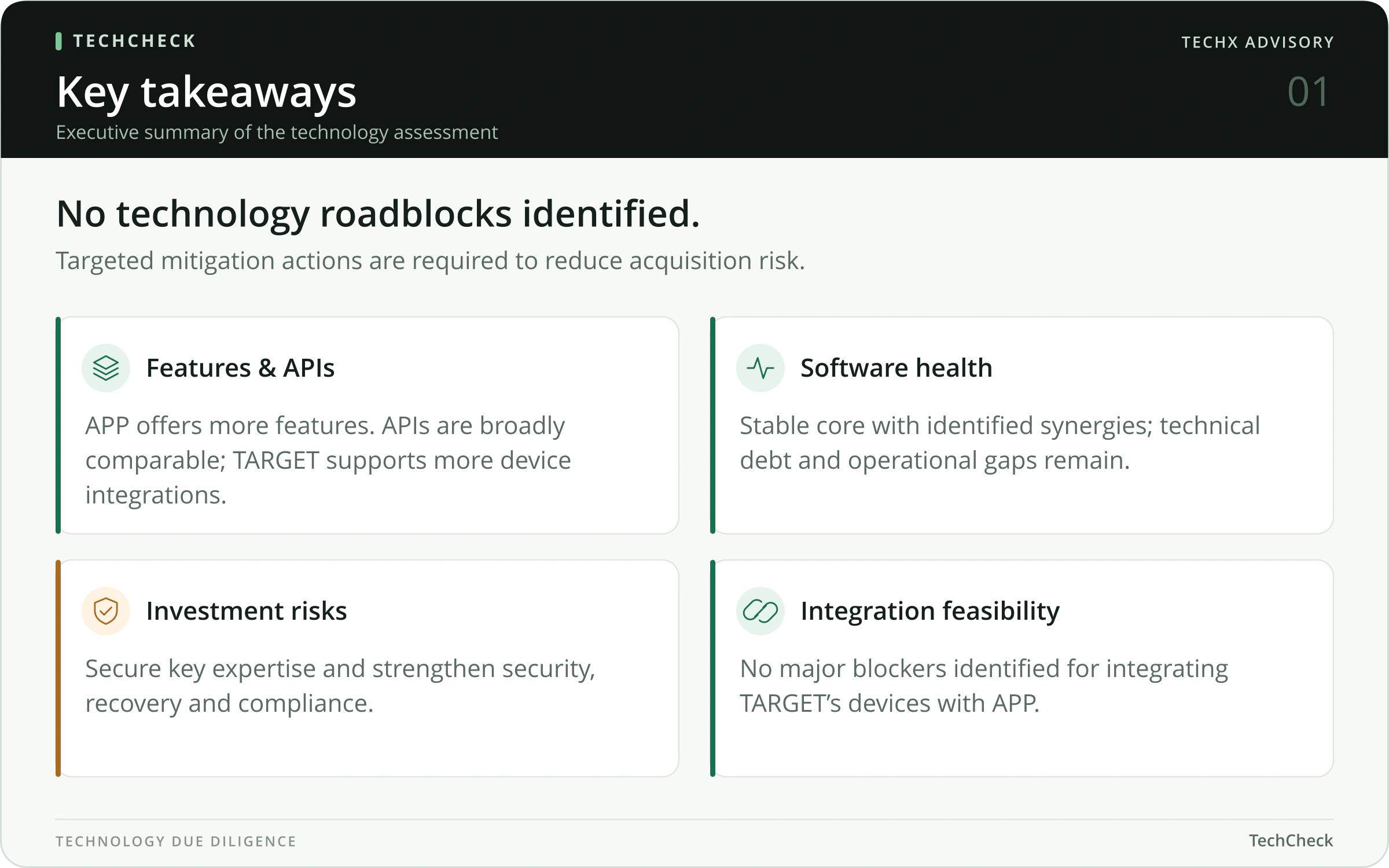
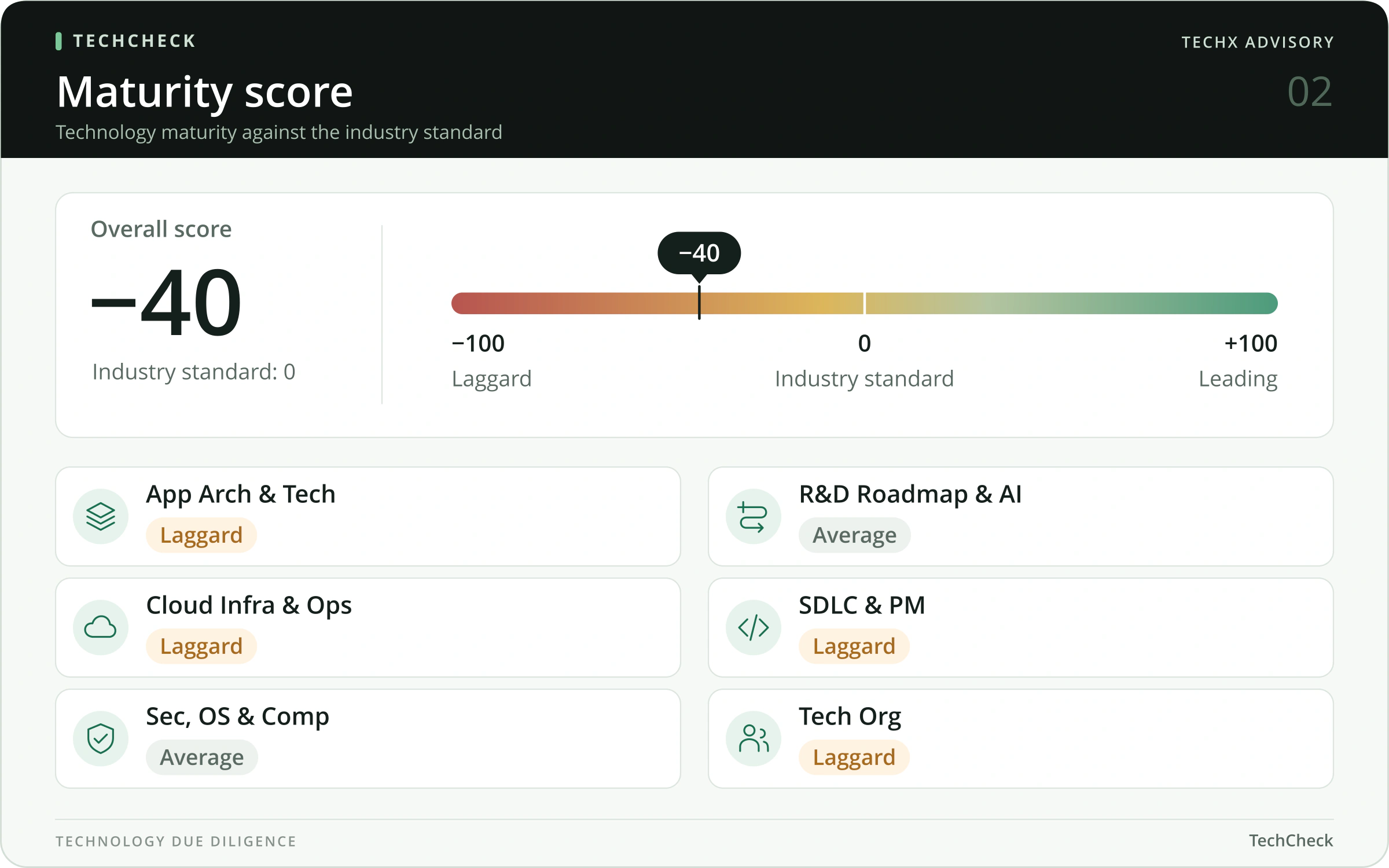
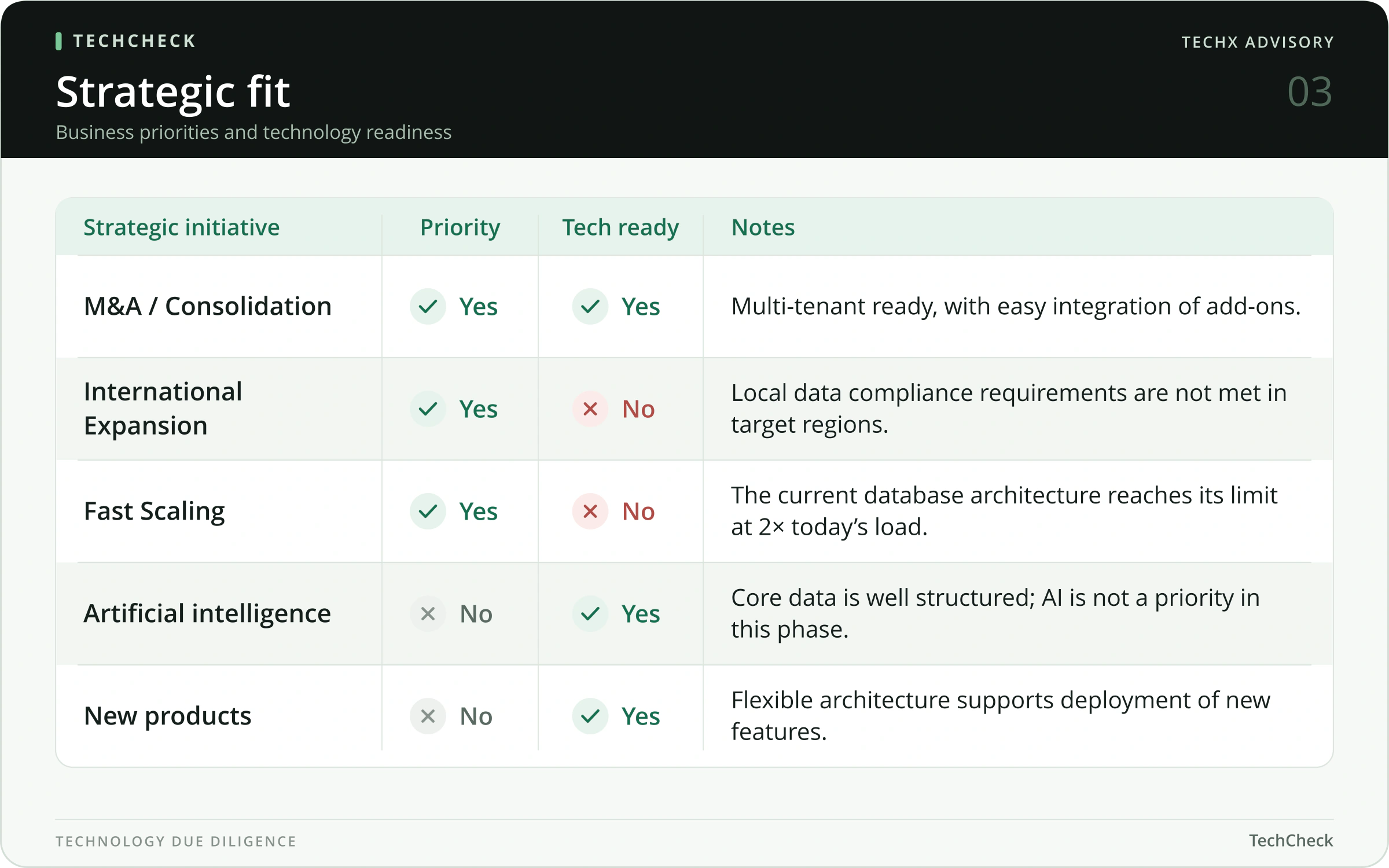
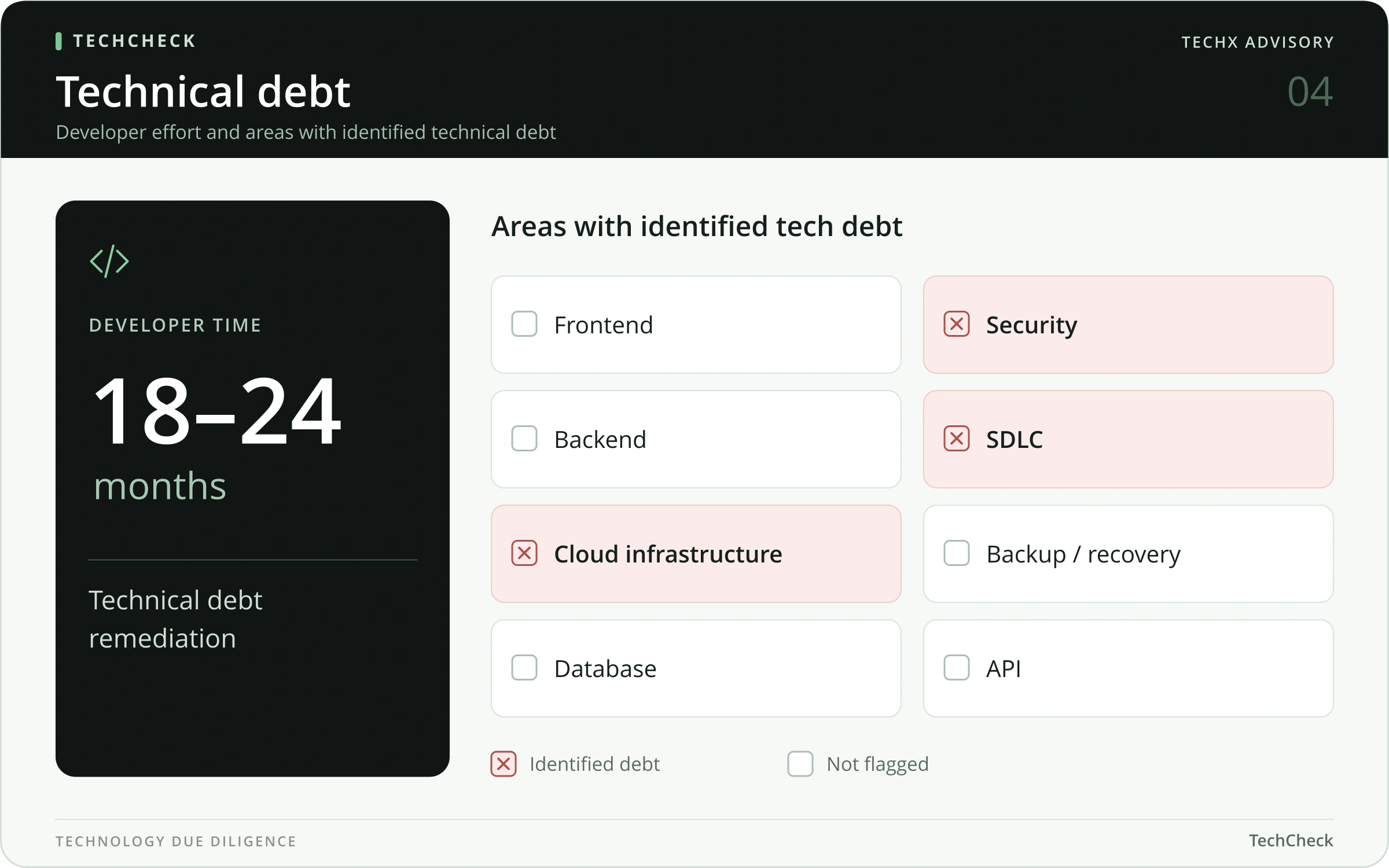
The executive summary should make the investment questions — and the engineering priorities — clear within minutes, not after fifty pages of technical detail.

INVESTOR PERSPECTIVE

Where is the risk? Is the technology fit for the plan? What investment will be required?

TECH MANAGEMENT PERSPECTIVE

What are we doing well? Where are the bottlenecks? What should we improve next?

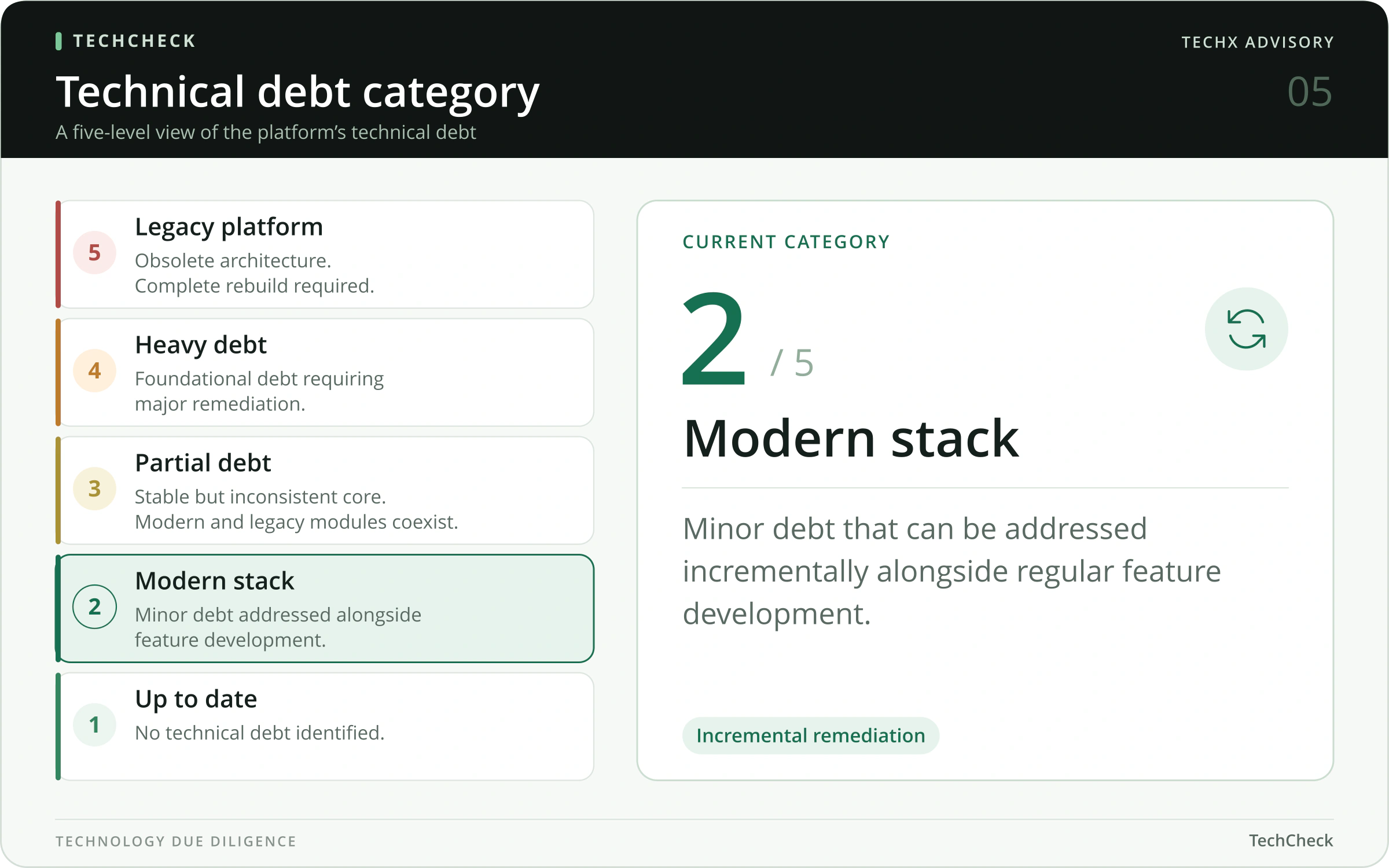
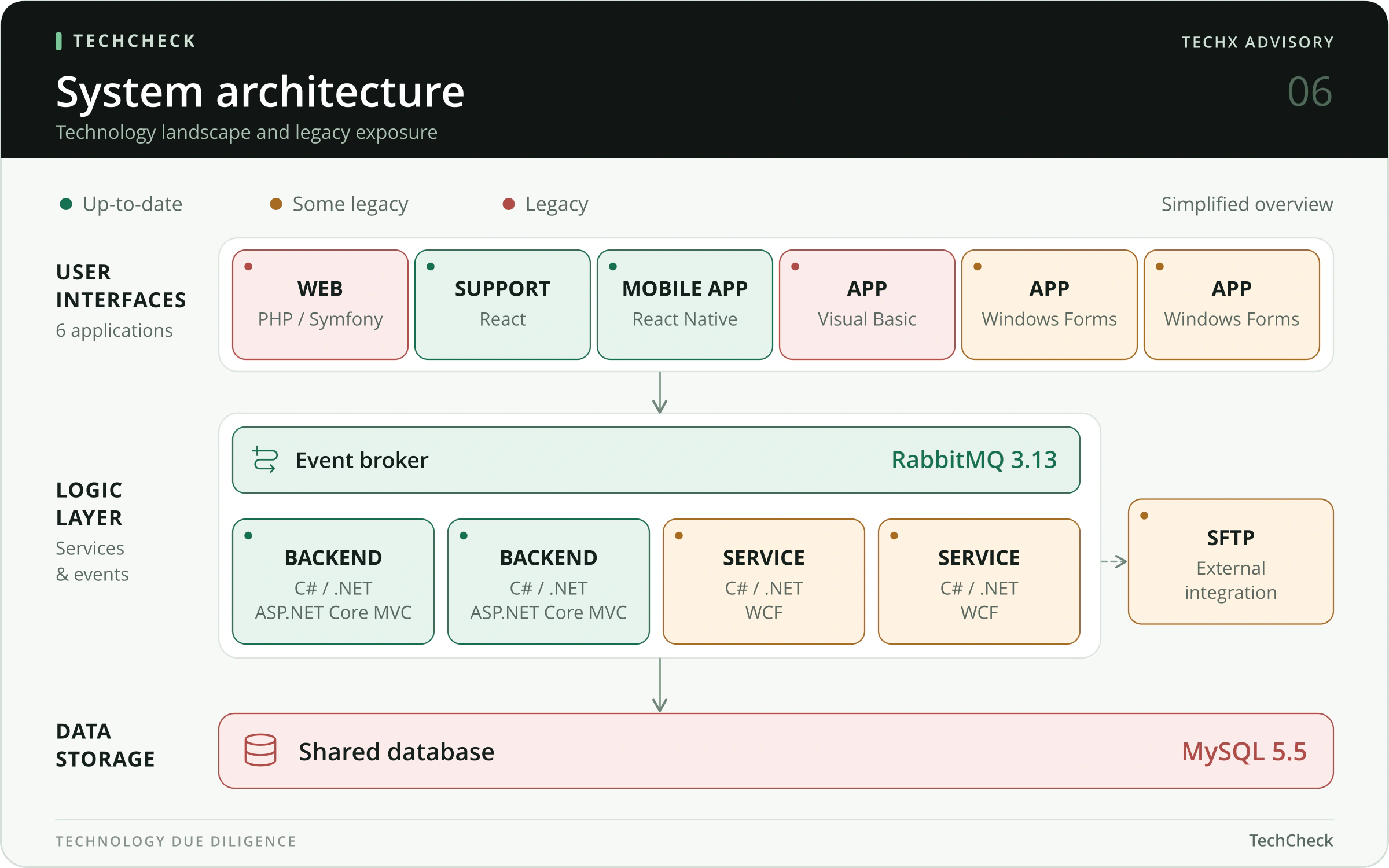
Illustrative report outputs. These examples demonstrate the types of executive summary insights TechCheck can provide. The shown values, scores, remediation estimates and architectures are illustrative — not measured findings about a current company or a guaranteed deliverable in every engagement.

PRODUCT · PROCESS · ORGANIZATIONDiscuss your own TechCheck

THE ESSENTIALS

A few things worth knowing.

Want the definition without the deep dive? Start here.

How is Tech DD different from IT Due Diligence?

Technology Due Diligence focuses on the product technology and engineering capabilities behind the offering. IT Due Diligence typically examines internal business systems, IT operations and infrastructure supporting the enterprise. Some assessments cover both.

Does a TechCheck always require source code access?

No. The need for access depends on the questions being investigated. Targeted demonstrations or reviews of representative code can be useful; an extensive source-code review is a separate scope decision.

Is TechCheck only for acquisitions?

No. The same structured assessment can be useful for a CTO or technology CEO seeking independent validation of architecture, delivery practices or readiness for the next stage of growth.

06 / THE NEXT CONVERSATION

Make your next investment
decision with confidence.

Let's discuss what the investment thesis demands of the technology — and how a focused TechCheck can help.

Discuss an investment

Discover what's possible
with your technology.

Let's explore where independent CTO expertise could help validate decisions, remove bottlenecks and sharpen the technology roadmap.

Discuss your technology